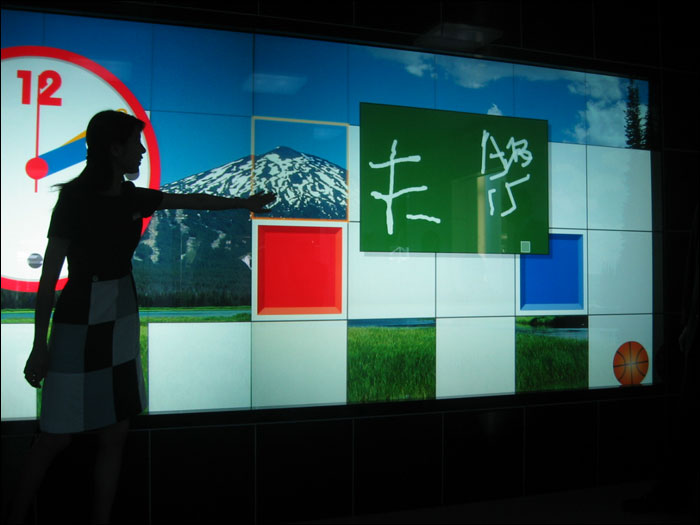
Mid-air Pan-and-Zoom on Wall-sized Displays
Authors - Mathieu Nancel, Julie Wagner, Emmanuel Pietriga, Olivier Chapuis, and Wendy Mackay
Authors Bios - Mathieu Nancel is a Ph.D. student in Human-Computer Interactions in the insitu team at the University of Paris-Sud.
Julie Wagner is a Postgraduate Research Assistant at the insitu lab and has a Master's from RWTH Aachen University.
Emmanuel Pietriga is the interim leader of the insitu lab and has a PhD from Institut National Polytechnique de Grenoble.
Olivier Chapuis is a team co-head (by interim) of the InSitu research team and has a PhD from the University of Paris VII Diderot.
Wendy Mackay is a Research Director with INRIA Saclay in France and has a PhD from MIT.
Venue - This paper was presented at the CHI '11 Proceedings of the 2011 annual conference on Human factors in computing systems.
Summary
Hypothesis - In this paper, researchers state that wall-sized displays are growing and popularity and yet have no standard for interaction. The researchers propose a series of possible interaction techniques with these displays. The hypothesis is that these mid-air interactions will be more effective than traditional hardware peripherals and will be preferred by users.
Content - The researchers intend to propose several possible interactions and then test them in user studies to see what is most effective. They rule out anything requiring 6 degrees of freedom and only suggest things using 3 degrees of freedom or less. They also exclude any predefined gestures that are used in touch interfaces as they do not relate in a good way. They narrow the gestures down to 3 key dimensions: Hands, Gestures, and Degree of Guidance. The comparison between unmanual and bimanual input has the researchers expecting bimanual to do better. Linear and circular gestures are also under consideration and the researchers propose using circular gestures for zooming and linear gestures for scrolling. The degree of guidance dimension has the researchers questioning the right feedback to give users as they interact in a primarily free space. The design choices were decided as follows:
- Panning - ray-casting using dominant hand
- Zooming - both linear and circular gestures accepted but most important part is pointing where the center should be while zooming in and out
- Bimanual interaction - dominant hand used for panning and pointing while non-dominant hand is used for zooming.
These interactions will be tested in the 1D path, 2D surface, and 3D free space allowing for input via device, touch-screen, and free hand respectively.
Methods - The researchers will study 12 unique interaction techniques in a user study. The 12 interactions come from using linear and circular gestures in both unimanual and bimanual modes in the 3 spaces mentioned above (1D, 2D, and 3D). The researchers expect to find that:
- Two handed gestures will be preferred to one handed gestures and be more accurate and faster
- Linear gestures will be preferred for zooming actions while circular gestures will be preferred for everything else
- 1D and 2D gestures will be faster than 3D gestures
- 1D gestures will be the fastest and 3D gestures will be the most tiring
There will be 12 participants testing these gestures on a wall-sized display consisting of 32 screens powered by 16 dual core computers capable of displaying 20480 X 6400 pixels. They will be performing a pan-zoom task that requires users to navigate and zoom appropriately among a series of circles with some designated as targets that should be focused on. The participants will rank the gestures during and after the study.
Results - The researchers found that as predicted two-handed gestures were faster than one handed ones and the 1D path gestures were the fastest of the 3 spaces. To the researchers surprise, linear gestures were faster than circular ones. Overshooting with circular gestures helps to explain why linear gestures performed better. Participant feedback supported the claims that two-handed gestures would be preferred to one-handed ones and that linear was preferred over circular gestures. The fastest overall gestures were two-handed linear ones in both the 1D and 2D space.
Conclusion - The researchers conclude by stating that they have provided more data to help with developing gestures for the mid-air space. They also state that gestures in the 1D and 2D space should not be forgotten as wall-sized displays become more common because they are less error prone and less tiring than gestures in the 3D space.
Discussion
I think the researchers achieve the goal of developing effective mid-air interaction techniques for wall sized displays. It's very interesting that the hardware based input methods were found to be preferable in many instances. We get caught up in movies today and think that free hand interaction is the ultimate goal for all input but studies like this show that those gestures actually have some hefty side affects that cannot be ignored when compared side by side with devised based input.

No comments:
Post a Comment